Drawing on more than 6,200 combined customer reviews and YouTube reviewer coverage, here's how the two stack up on the dimensions that actually matter.
| Breville Control Grip | Cuisinart Smart Stick | |
|---|---|---|
| Image | 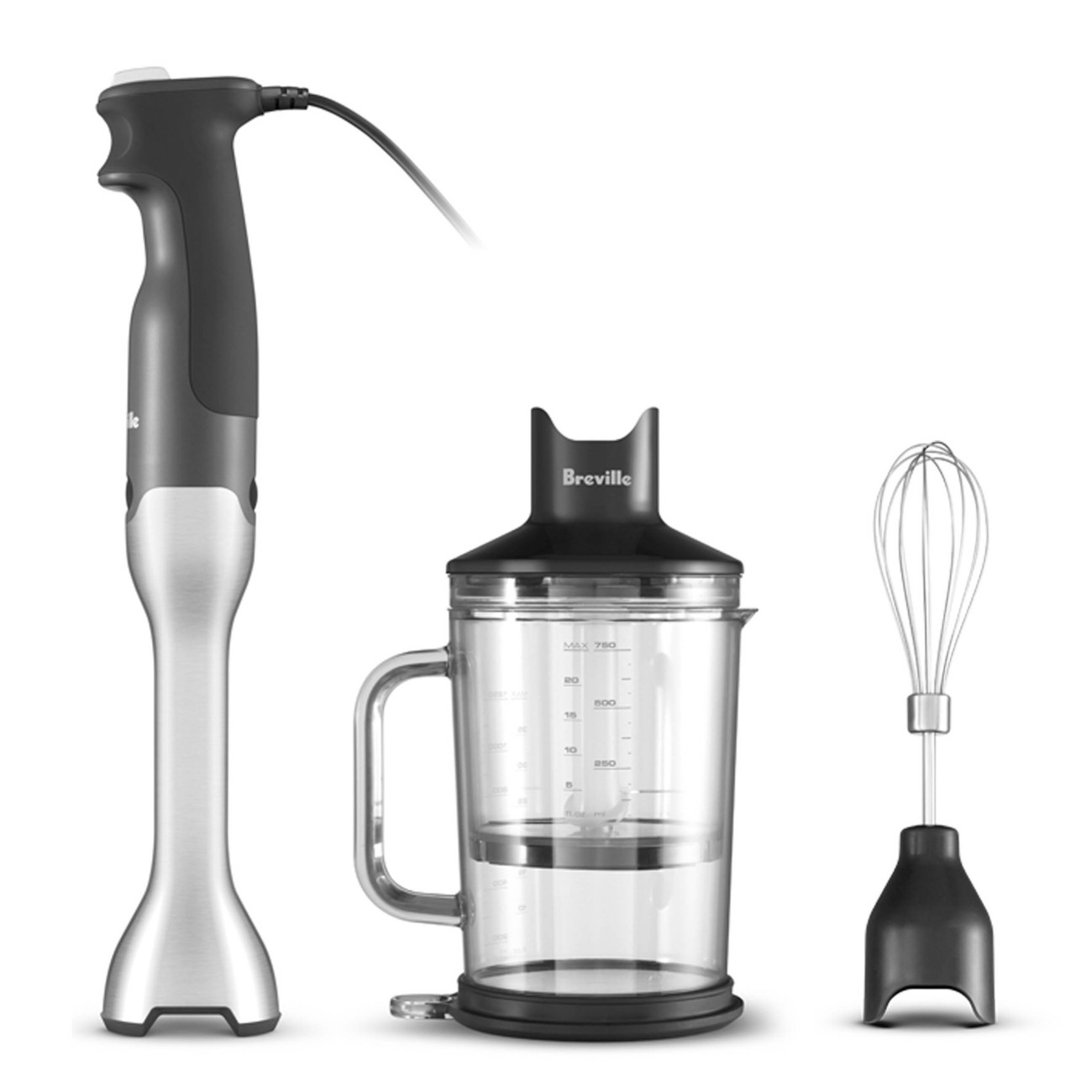 |
 |
| Customer rating | 4.5 ★ (3,486) | 4.6 ★ (2,754) |
| Confidence | 100/100 | 99/100 |
| Price | ~$130–$150 | ~$40 |
| Buy | Check on Amazon | Check on Amazon |
What Owners Say About the Breville Control Grip
4.5★ across 3,486 customer reviews · Confidence: 100/100 · ~$130–$150
According to the 3,486 customer reviews on Amazon, the Control Grip's standout feature is its ergonomic trigger grip — owners consistently describe it as less fatiguing during longer blending sessions compared to a standard on/off switch. The bell-shaped blade guard is another frequent talking point: reviewers report it creates a seal against the bottom of a pot that dramatically reduces splashing when blending hot soups. Owners who cook in volume — large batches of sauce, frequent soup nights — call out the variable-speed control as the feature that makes the premium feel justified. The most common caveat is the price itself: several owners note they had to talk themselves into spending this much on a stick blender, and a handful report the unit is bulkier than expected, making storage tighter in smaller kitchens.
Read the full review → · Check price on Amazon →
What Owners Say About the Cuisinart Smart Stick
4.6★ across 2,754 customer reviews · Confidence: 99/100 · ~$40
The Cuisinart CSB-75 earns a 4.6-star average across 2,754 reviews — a higher raw rating than the Breville — and owners are emphatic about why: it does everything a typical home cook needs at a price that removes the hesitation. Reviewers praise its reliability for soups, smoothies, baby food, and sauces, often noting they've owned one for years without issue. The two-speed operation is frequently described as "all you actually need" for everyday tasks. The most common criticism in customer feedback is performance at the extremes — owners note the motor can labor through very thick mixtures or extended continuous use, with some suggesting it's better suited to lighter-duty, shorter blending jobs than to high-demand cooking routines.
Read the full review → · Check price on Amazon →
Where They Differ
The price gap is the headline difference — roughly $90–$110 separates these two, which is more than double the cost of the Cuisinart on its own. That gap isn't arbitrary: it largely reflects the Breville's stainless-steel construction, more powerful motor, and the ergonomic variable-speed trigger that owners describe as a genuine usability upgrade over a push-button switch.
Speed control is where owners most often draw the line. Breville reviewers frequently mention dialing in exactly the right texture for a given dish — a coarser pulse for a rustic soup versus a finer blend for a velvety sauce — as something they now take for granted. Cuisinart owners more often describe flipping between two speeds and finding that perfectly adequate. Neither group is wrong; it depends on how much granularity your cooking actually demands.
Splatter control comes up repeatedly in the Breville feedback, with the bell-shaped guard credited for making blending hot liquids noticeably less messy. This detail is largely absent from Cuisinart reviews — not because owners are unhappy, but because it isn't a feature the CSB-75 was designed around.
Durability framing differs as well. Breville owners often reference the stainless-steel shaft as a reason they expect the blender to last, while Cuisinart owners more frequently describe their unit as a no-regrets purchase even if it eventually needs replacing — at $40, longevity carries less weight in the value calculation.
How We Compared
The Confidence score combines a product's star rating with the number of people who gave it — a 4.5-star product backed by 3,000 reviewers is a harder rating to argue with than a 4.5-star product backed by 30. The top scorer in each comparison is rescaled to 100, and the other product is expressed relative to that ceiling. Well Seasoned's individual reviews consolidate Amazon customer feedback and YouTube reviewer coverage; this comparison aggregates those reviews. Prices and ratings reflect values recorded at the time of each individual review and may have changed.
When to Choose Which
| If you care most about… | Choose — why |
|---|---|
| Highest customer rating | Cuisinart CSB-75 — 4.6★ vs 4.5★ |
| Largest body of customer feedback | Breville Control Grip — 3,486 vs 2,754 reviews |
| Lower upfront price | Cuisinart CSB-75 — ~$40 vs ~$130–$150 |
| Premium pick (budget not the constraint) | Breville Control Grip — variable speed, stainless build, and splatter-reducing bell guard backed by the larger review base |
| More granular speed control | Breville Control Grip — variable-speed trigger vs two fixed speeds |
Pick the dimension that matches what you care about — neither is universally better.