Bialetti Moka Express 6-Cup Review: The $40 Stovetop Classic That Still Pulls Its Weight

The Bialetti Moka Express is the coffee maker most Italian kitchens have on the back of the stove, and for under fifty dollars it remains one of the highest-value pieces of brewing gear you can own. It isn't a real espresso machine — let's get that out of the way up front — but for thick, dark, concentrated coffee that you can stretch into a passable americano or a serious latte, the 6-cup Moka Express is hard to argue with.
What you're actually buying
The Moka Express is a three-piece aluminum stovetop brewer designed by Alfonso Bialetti in 1933 and still made in essentially the same form: a faceted octagonal base (the boiler), a funnel-shaped coffee basket that drops into it, and an upper chamber with a small spout and a black phenolic handle. The "6-cup" label refers to Italian espresso-style cups of roughly 50 ml each, so the actual yield is about 300 ml — closer to two American mugs than six servings.
Key facts worth knowing before purchase. The body is cast aluminum, not stainless steel, which matters for two reasons: it conducts heat fast, and it is not induction-compatible without a separate magnetic disc (Bialetti sells a steel "Moka Induction" version for that use case). The gasket and filter plate are user-replaceable and are inexpensive — important, because they wear out. Sizes go from 1-cup up through 12-cup; the 6-cup is the most flexible if you brew for one or two people daily. The pot is hand-wash only; the dishwasher will dull the aluminum and degrade the seal.
Performance and real-world use
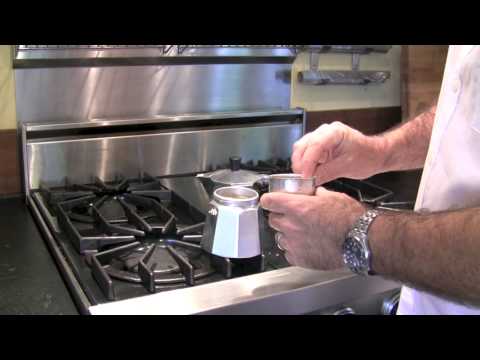
Brewing is simple in description and finicky in practice. You fill the bottom chamber with water up to the level of the safety valve, pack ground coffee loosely into the funnel basket (no tamping — that's a beginner mistake that stalls the brew), screw the top on firmly, and put it on medium-low heat. After three to five minutes you hear a gurgle as steam pressure forces water up through the grounds and into the upper chamber. The moment that gurgling turns to a hiss, you pull it off the heat.
The output is not espresso. Real espresso runs at roughly 9 bars of pressure; a moka pot generates about 1.5 bars. What you actually get is a strong, full-bodied, slightly bitter coffee with a thin layer of brown foam on top that is not true crema. The flavor leans toward dark chocolate, caramelized sugar, and (if you over-brew) a sharp metallic note that fans of pour-over or French press will recognize as bitterness. Dialing in grind size — somewhere between drip and espresso, closer to fine-table-salt than powder — fixes most of the bitterness complaints.
Two practical notes. First, the aluminum needs a few brews to "season" before the coffee stops tasting faintly metallic; don't judge it on day one. Second, glass-top electric stoves can be a problem because the octagonal base contacts the surface unevenly and can rock if the burner element doesn't sit fully under it. Gas, induction with an adapter, or a small camp stove all work better than a flat electric coil.
- Genuinely cheap entry point into concentrated, espresso-style coffee at home
- Mechanically simple — no electronics, no pump, no software to break
- Replacement gaskets and filter plates are widely available for a few dollars
- Small enough to travel with; works on any open flame including a camp stove
- Iconic design that fits in any kitchen and lasts decades with basic care
- Brews fast — three to five minutes from cold water to coffee
- Not real espresso — no 9-bar pressure means no true crema, and the texture is thinner
- Aluminum body is hand-wash only and not dishwasher safe
- Standard version is not induction-compatible (you need the steel Moka Induction model)
- Easy to over-extract and end up with a bitter, burnt-tasting brew if you walk away
- Octagonal base can wobble on flat glass-top electric stoves
Anyone who wants strong, dark coffee at home without spending $700 on a real espresso machine. It's also a good fit for travelers, campers, and small kitchens where a full setup isn't realistic. If you already drink milk-based coffee — lattes, cortados, cappuccinos — the Moka makes a credible base, especially with a handheld milk frother.
If you want actual espresso with crema and a proper shot profile, save up for a real pump machine; the Moka will only frustrate you. Skip it too if you only have an induction cooktop and don't want to buy either the steel induction model or a separate adapter disc. And if you primarily drink filter-style coffee — light roasts, floral notes, clarity — you'll find this brewer punishingly heavy-handed.
For roughly $40, the 6-cup Bialetti Moka Express is one of the easiest recommendations in coffee. It does one thing — strong, dark, concentrated coffee — and does it with mechanical reliability that almost no electric appliance at this price can match. Just go in knowing it's a moka pot, not an espresso machine, and you'll love it for years. **Rating: 4.5/5.**