HexClad Hybrid 14-Piece Cookware Set Review: The Honest Take After The 2025 Lawsuit

HexClad sells a clever idea: one pan that sears like stainless steel and releases like nonstick, in a complete kitchen set you never have to upgrade. Gordon Ramsay endorses it. The pans cost what an entry-level cookware set costs three times over. They are also the subject of a 2025 class-action settlement over how the brand marketed its coating. After two years of independent long-term reviews and one expensive lawsuit, the picture is clearer than the marketing makes it look — and it is more interesting than either the fans or the critics admit.
What's in the box
The 14-piece set includes 8", 10", and 12" frying pans with lids, 2-quart, 3-quart, and 8-quart pots with lids, and two silicone trivets. Lids are tempered glass with steel rims. Handles are stainless and designed to stay cooler than fully-clad equivalents. Everything is induction-compatible and oven-safe to 900°F (steel components) or 400°F (anything with the tempered glass lid).
That covers what most home kitchens need: small egg pan, weeknight skillet, sear pan, sauce pot, everyday pot, and a stockpot for soup and pasta. The omission is a sauté pan with high straight sides — if you braise often, you'll want to add the deep sauté separately.
How the hybrid surface actually works
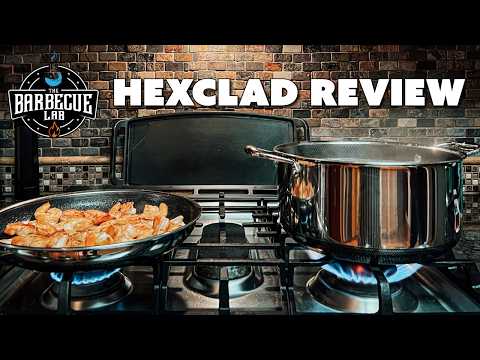
The cooking surface is the whole pitch. HexClad uses a tri-ply body (stainless–aluminum–stainless), then laser-etches a hexagonal pattern of raised stainless ridges, and fills the recessed valleys with a ceramic-blend nonstick coating. The idea: food touches the stainless peaks (so it browns and you can use metal utensils on the high points), while the coated valleys release sauces and starches.
In practice that means the pan behaves like neither pure stainless nor pure nonstick. You can get a sear on a steak — better than a typical PTFE pan, not as good as bare stainless or cast iron — and eggs slide if the pan is properly preheated and lightly oiled. It is genuinely a hybrid, with the trade-offs that word usually hides.
Performance and real-world cooking
Heat distribution is even and quick across the bottom. Induction performance is strong; the pans react fast and hold temperature steadily. The 12-inch skillet is the workhorse of the set and handles everything from morning eggs to a Sunday steak with the same hardware.
The stay-cool handles are a noticeable upgrade over fully-clad sets. They warm up under sustained high heat but stay manageable for most stovetop cooking — you still want a glove for oven transfers above 400°F.
The catch: nonstick performance depends on preheating discipline. Drop a cold egg into a cold HexClad pan and it sticks just like cheap stainless would. Preheat, add a thin film of fat, and it releases cleanly. Most negative reviews come from cooks who used the pan like a Teflon skillet and discovered it doesn't behave like one when cold.
Searing performance is the genuine surprise. Because the raised stainless ridges contact the food, you do get fond development and a real crust. It is not as aggressive as bare carbon steel, but it is meaningfully more capable than any pure nonstick.
Long-term durability — what 2 years of testing shows
Multiple independent long-term reviews (Tom's Guide, She Knows, The Kitchn, Prudent Reviews) have now run HexClad pans through 14 to 36 months of daily use. The pattern that emerges:
- Most testers report the pans hold up well past the two-year mark, with the hex ridges visibly intact and nonstick performance largely preserved with proper care.
- A minority of buyers report nonstick wear in the valleys between hex ridges as early as 8 months, with food beginning to stick in spots.
- The dishwasher is technically allowed but is the most-cited cause of premature dulling and surface etching. Hand-washing extends the surface life noticeably.
- The hex ridges themselves are extremely durable — that part of the marketing largely holds.
This is more durable than mid-tier nonstick (which typically degrades inside a year) but less reliably durable than fully-clad stainless (which lasts decades). You are paying clad-stainless prices for nonstick-style longevity, which is the central honest critique of the line.
The 2025 lawsuit, plainly
In 2025, HexClad settled a $2.5 million class-action lawsuit over claims that it had marketed its cookware as "non-toxic," "PFOA-free," and "PFAS-free" while the nonstick coating uses PTFE — which is itself a PFAS compound. HexClad denied wrongdoing but agreed, as part of the settlement, to stop using those specific labels on its PTFE-coated products going forward.
What this means in practice: the pans are not more toxic than any other PTFE-coated nonstick pan on the market. PFOA — the more notorious compound — has been phased out of cookware coatings industry-wide for years, including HexClad's. But the broader "PFAS-free" claim was not accurate, and buyers who specifically wanted PFAS-free cookware (which is a defensible preference) should look at fully ceramic-coated lines or unenameled cast iron and carbon steel instead. The lawsuit was about marketing language, not about a sudden health hazard.
If this is a deal-breaker, the set is not for you. If it isn't, the cooking performance discussion above is what actually matters.
- Real searing plus real release — the hybrid surface delivers on both jobs better than most competing "do everything" nonstick lines
- Strong induction performance — fast, even, stable on every cooktop type
- Stay-cool handles — a meaningful daily quality-of-life improvement
- 900°F oven-safe (without glass lid) — covers any home use, including high-heat finishing
- Metal-utensil safe on the ridges — you don't have to keep a dedicated silicone-only drawer for these
- Lifetime warranty against manufacturer defects — HexClad has been consistently responsive on warranty claims in user reports
- Most long-term tests stay positive past 2 years — durability is better than typical nonstick, even if not the universal home run the marketing implies
- Premium price for hybrid performance — costs as much as a comparable clad stainless set without matching its lifetime
- Cold-start sticking — needs preheating discipline; not the forgiving Teflon experience first-time buyers sometimes expect
- Dishwasher dulls the surface — technically allowed, practically a bad idea
- Minority of users report nonstick wear before the 1-year mark — outcomes are not uniform
- Contains PTFE coating — the 2025 settlement cleaned up the marketing language but the underlying chemistry is the same as other quality nonstick lines; not a PFAS-free option
- No deep sauté pan in the 14-piece configuration — most other pieces are well-chosen, but braisers will need an add-on
Cooks who want one cohesive set that can sear a steak, scramble eggs, and simmer a stew without juggling separate stainless and nonstick stacks. Buyers who care about handle comfort, induction performance, and the aesthetic of a matching set. Anyone who will commit to hand-washing and preheating — the two behaviours that make the difference between a five-year set and a fifteen-month set. People with the budget to treat cookware as a one-time purchase rather than something replaced every few years.
Anyone who specifically wants PFAS-free cookware — pick fully ceramic-coated, unenameled cast iron, or carbon steel instead. Cooks who want the absolute best sear money can buy — bare stainless and cast iron still win that race, and at lower prices. Anyone who will inevitably put the set in the dishwasher and isn't going to change that habit. Buyers who'd be just as happy with a $200 nonstick set replaced every two years — the maths there genuinely doesn't favour HexClad.
HexClad's 14-piece set is a real product, not a gimmick — but it isn't quite the miracle the marketing claims either. The hybrid surface does both jobs to a meaningful degree, durability outperforms typical nonstick, and the build quality matches the asking price. The 2025 lawsuit is worth knowing about, but it is a marketing correction, not a safety scandal: anyone comfortable with PTFE nonstick generally has no new reason to avoid these pans, and anyone uncomfortable with PTFE should never have been in this category to begin with. The honest summary is this: if you want one set that handles everything, you cook actively, you'll hand-wash, and the price doesn't sting — buy it. If any of those four conditions don't apply, your money is better spent elsewhere. **4/5 — Genuinely good hybrid cookware at a luxury price; rewards buyers who treat it accordingly.**
Sources
- Amazon product page — HexClad Hybrid 14-Piece Set (B0CVH77YZ7)
- HexClad Cookware Review — Prudent Reviews
- HexClad Review: How the Cookware Is Holding Up After 2+ Years of Heavy, Daily Use — She Knows
- HexClad Cookware Review: 3 Editors Tried the Hybrid Pan (2026) — Taste of Home
- Is HexClad Cookware Worth the Price? My Honest Review (2026) — The Kitchn
- I was introduced to HexClad by Gordon Ramsay himself — 3-year verdict — Tom's Guide
- HexClad cookware reviews and class-action settlement coverage — Trustpilot
- HexClad hybrid pan review — Homes & Gardens