KitchenIQ 50009 Edge Grip Knife Sharpener Review: Worth $10?

The KitchenIQ 50009 is a two-stage pull-through knife sharpener that has accumulated more than 80,000 Amazon ratings by doing one thing well: making dull kitchen knives functional again at a price that removes all hesitation from the buying decision. It's not a precision tool — it removes significant metal, won't match a whetstone's edge, and is off-limits for Japanese or high-end knives. But for the home cook with a drawer full of mid-range Western knives that haven't seen a sharpener in years, it delivers a working edge in under a minute.
Product Overview
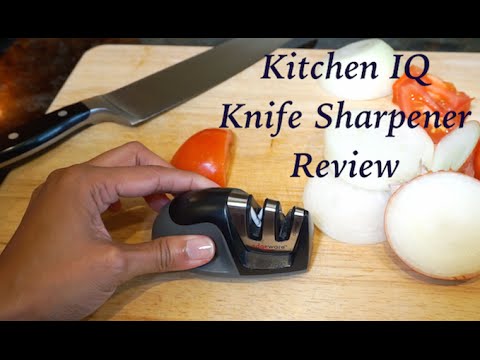
The 50009 is a handheld pull-through sharpener with two sequential slots, each performing a different function on the blade as you draw it through.
| Spec | Detail |
|---|---|
| Stage 1 — Coarse | Tungsten carbide V-blades; quickly sets or repairs a damaged edge |
| Stage 2 — Fine | Ceramic rods; polishes and hones the finished edge |
| Dimensions | Approx. 3.5" L × 2" W × 2" H |
| Weight | 1.6 oz |
| Colors available | Black (B001CQTLJM), Green (B0182LWE52) |
| Knife compatibility | Straight-edge and serrated Western-style knives |
| Price | ~$9–10 |
The headline design feature is the patented "V-grip" — a notch on the bottom that lets you hang the sharpener over the edge of a table or countertop, so the tip of a longer knife doesn't scrape the surface while you work. A rubberized non-slip base handles standard flat use. The whole unit is small enough to tuck into a utensil drawer alongside the knives it services.
Color choice (black or green) is purely cosmetic. The mechanics are identical.
Performance & Real-World Use
The coarse stage draws the knife through two tungsten carbide blades arranged in a "V," removing metal from both sides of the blade simultaneously to create a new edge. It works — blades that felt dull come out noticeably sharper, typically in 5–10 pulling strokes for a mildly neglected knife.
The important qualifier: "sharper than before" is not the same as "sharp." Independent performance testing found the 50009 reaching what testers described as a ripe-tomato level of sharpness — adequate for everyday slicing, but not the clean, effortless bite a quality whetstone or electric sharpener produces. Testing also found sharpening times notably slower than higher-priced pull-through and electric alternatives.
The carbide stage is aggressive. It removes more metal per stroke than a sharpening stone, which means over months and years of use, it shortens blade life faster than a less abrasive method. The best practice from multiple reviewers: use the coarse stage only when a knife is genuinely dull, not as a daily routine.
The fine ceramic stage is better treated as a standalone touch-up tool than as the second half of a full sharpening. The grit jump from coarse to fine is steep — there is no medium step — so it can't fully smooth the scratches left by the carbide stage. Used on its own for a blade that's only slightly tired, a few strokes through ceramic can refresh the edge without the metal removal.
Stability is solid on dry countertops. On wet or greasy surfaces, the rubber base loses grip noticeably, which matters in an active kitchen.
A hands-on review from a professional knife-maker confirmed the device can produce an edge sharp enough to cleanly slice printer paper after roughly 10 strokes in each stage. Sharp enough for a home kitchen is the accurate frame.
- Price eliminates hesitation — $9-10 puts it firmly in impulse-buy territory, with no complicated ROI calculation required
- Compact enough to forget about — smaller than a deck of cards, 1.6 oz, stows in a drawer without displacing anything
- Fast for basic maintenance — a neglected mid-range knife gets a working edge in under a minute
- V-grip countertop feature — prevents knife tips from dragging, a thoughtful touch for longer blades
- Works on serrated knives — whetstones and many electric sharpeners cannot say this
- Zero learning curve — the angle is preset; pull the blade through and you are done
- 80,000+ ratings — years of real-world data from actual home kitchens
- Aggressive metal removal — the tungsten carbide stage is hard on blades; repeated use meaningfully shortens a knife's lifespan compared to finer sharpening methods
- Moderate sharpness ceiling — professional testing confirmed it reaches only an adequate, not exceptional, edge
- Slow by category standards — timed tests showed notably longer sharpening times than similarly-priced or slightly more expensive alternatives
- Fixed 20° bevel only — cannot accommodate the 15° angles of Japanese knives; using it on them will damage the geometry
- No medium-grit stage — the gap between coarse carbide and fine ceramic is wide, limiting the quality of the finished edge
- Stability degrades on wet or dirty surfaces — a realistic hazard during active cooking
- Ceramic can load up with debris — some long-term users report the fine stage losing effectiveness over time as metal particles accumulate
The KitchenIQ 50009 does what it promises at a price that makes the promise easy to accept. It won't match a whetstone's edge, and the carbide stage removes more metal than ideal for long-term blade health. But for the average household knife collection that sees more weeknight dinners than precision work, it turns a dull knife into a functional one in under a minute — and does so for less than the cost of lunch. **4/5** — points off for the aggressive coarse stage and the moderate sharpness ceiling, but at this price and with this simplicity, the value case is nearly impossible to argue with.
Sources
- KitchenIQ 50009 Knife Sharpener In-depth Review — Healthy Kitchen 101 / ShouldIt.com
- KitchenIQ 50009 Review Analysis + Pros/Cons — TheReviewIndex.com
- KitchenIQ 50009 Edge Grip Knife Sharpener Review — Goodz4U
- KitchenIQ 50009 Review — CutleryAdvisor
- Kitchen IQ 50009 Edge Grip 2 Stage Knife Sharpener Review — YouTube (bestkitchenreviews)