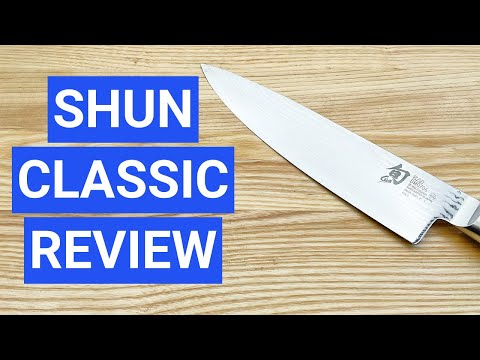
Shun Classic 8" Chef's Knife (DM0706) Review: The Japanese Edge Worth The Care

The Shun Classic 8" Chef's Knife (DM0706) is the knife most home cooks reach for when they want to "upgrade" from a Wusthof or Victorinox without going full handmade-Sakai. It pairs a hard VG-MAX steel core with hammered Damascus cladding and a D-shaped Pakkawood handle, and at around $170 it sits squarely in the premium-but-attainable Japanese knife tier. Bottom line: it's a fantastic slicer with a thinner, sharper geometry than European workhorses — provided you treat it like the Japanese knife it is.
What you're actually buying
The DM0706 is the 8-inch chef's knife in Shun's flagship Classic line, made in Seki, Japan. The blade is a VG-MAX steel core sandwiched between 32 layers of softer stainless cladding, producing the wavy Damascus pattern Shun is known for. It's hardened to roughly HRC 60–61, sharpened to a roughly 16-degree edge per side, and the spine and choil are eased rather than left squared off.
The handle is D-shaped Pakkawood — a resin-impregnated hardwood that's stable, attractive, and biased toward right-handed users (a true left-handed version exists separately). The knife runs around 7.4 ounces, which feels light in hand compared to a German 8-inch but reassuringly substantial compared to a budget Japanese gyuto.
You get a paper sleeve and a slim box. There's no saya, no honing rod, and no storage block — accessories are sold separately, which is normal at this price point but worth knowing if you're starting fresh.
Performance and real-world use
Out of the box, the edge is genuinely sharp — paper-test sharp, tomato-skin-without-pressing sharp. The thin geometry behind the edge is the real story. Onions glide rather than wedge, herbs chiffonade cleanly without bruising, and push-cutting through butternut squash takes noticeably less force than a thicker German blade. Rock-chopping works but isn't its strength; the gentler belly curve rewards a push-and-pull or tip-pivot motion.
The Damascus cladding is mostly cosmetic, but the trade-off it represents — a hard core surrounded by softer, more forgiving steel — does seem to help with chip resistance compared to fully mono-steel Japanese knives at the same hardness. Food release is decent but not exceptional; the hammered finish ("tsuchime") on some related Shun lines isn't present on the standard DM0706, so sticky items like cucumber and potato will still cling.
Edge retention is good but not magical. With careful use on a wood or composite board, expect to need a ceramic hone every few weeks and a proper sharpening (whetstone, or a Shun-approved service) once or twice a year. The VG-MAX steel is harder than most German knives, so it holds an edge longer — but when it does dull, you can't bring it back with a steel rod the way you would a Wusthof. That's the central trade.
- Excellent factory edge with thin, slicing-forward geometry that outperforms most German knives on produce
- VG-MAX core holds an edge meaningfully longer than 1.4116 or X50CrMoV15 steels
- Damascus cladding adds chip resistance and looks beautiful without being purely decorative
- D-shaped Pakkawood handle is comfortable for medium-to-large right hands and shrugs off moisture
- Made in Japan with a lifetime warranty against manufacturing defects and free sharpening from Shun
- Strong resale value if you ever decide to move on
- D-handle is awkward for left-handed users; a dedicated left-handed SKU costs extra and is harder to find
- Hard steel means edge maintenance requires a ceramic rod or whetstone — a regular honing steel can damage the edge
- Not built for hard tasks like splitting bone-in chicken or hacking through frozen food, and Shun's warranty doesn't cover chips from misuse
- Cosmetic Damascus pattern shows water spots and patina if not dried promptly after washing
- No saya, sheath, or storage included at a $170 price point
Home cooks who already know how to handle a knife and want a meaningful step up from a German workhorse. People who do a lot of vegetable, herb, and protein prep and will notice the difference in how a thinner Japanese edge moves through food. Anyone willing to dry the knife by hand after use and learn to use a ceramic rod or send it out for sharpening.
Cooks who routinely chop through bones, frozen items, or hard winter squash without a heavier cleaver around — that's how Shuns get chipped. Lefties who don't want to pay extra for the dedicated handle. Anyone who throws knives in the dishwasher, leaves them in a wet sink, or wants a "set it and forget it" knife they can ignore for years. Also probably overkill for cooks who only cook a couple of nights a week — a Victorinox Fibrox at a third of the price will serve you well.
The Shun Classic 8" Chef's Knife earns a solid 4.5/5. The geometry, steel, and fit-and-finish all justify the price, and for the right user it's a knife that genuinely changes how prep feels. The half-point comes off because the D-handle limits its audience and the hard steel demands a level of care that not every buyer is prepared for. Match it with a ceramic honing rod and a wood cutting board and it'll outlast most of your other kitchen gear.