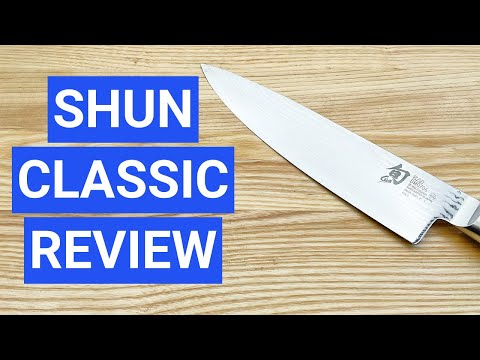
Shun Premier 7-Inch Santoku Knife Review: A Hammered Damascus Workhorse for Vegetables and Beyond

The Shun Premier 7-Inch Santoku (model TDM0702) is one of the most recognizable Japanese-style knives in the U.S. market — a hammered, walnut-finished blade with a thin geometry and a famously sharp factory edge. Bottom line: if you cook a lot of vegetables and want a lighter, more precise alternative to a Western chef's knife, the Premier Santoku is hard to beat at this tier — provided you treat it like a Japanese knife, not a hatchet.
What you're actually buying
The Premier Santoku is a 7-inch (about 178 mm) Japanese-style vegetable and general-purpose knife built around a VG-MAX steel core clad with 68 layers of Damascus stainless. Shun lists the cutting angle at roughly 16 degrees per side, which is noticeably more acute than a typical European 20-degree edge.
Three features distinguish the Premier from Shun's plainer Classic line: a hand-hammered tsuchime finish across the upper half of the blade, a walnut-toned PakkaWood handle with a contoured D-shape, and an exposed end cap that gives the knife a slightly more rustic look than the polished Classic. The hammered dimples are functional in addition to being decorative — they trap small air pockets that help release sticky foods like potato slices off the side of the blade.
The knife is handcrafted in Seki City, Japan, where Kai (Shun's parent company) has been making cutlery for generations. It comes in a simple paper-wrapped box rather than a presentation case at this price point.
Performance and real-world use
A santoku is not a chef's knife. The blade is shorter, the tip is much lower, and the profile is flatter, which encourages a push-cut or chopping motion rather than the rolling rock-cut you use with a Western chef's knife. Once you adjust, the Premier rewards you with very clean, very controlled cuts — particularly on dense vegetables like carrots, sweet potatoes, and butternut squash, where the thin grind glides through with minimal wedging.
Out of the box, the edge is genuinely sharp; this is one of the few production knives where the "shaves arm hair" cliché actually applies. The hammered finish does most of what Shun claims — onions and potato rounds release more easily than they do on the flat-ground Classic — but it is not magic, and very wet starch will still cling.
The handle is the polarizing part. The D-shape is mildly right-handed (left-handers can use it, but the contour favors a right hand) and runs slimmer than a Wusthof or Henckels handle. Cooks with larger hands sometimes find it cramped on long prep sessions. Balance sits just behind the bolster, which keeps the tip light and nimble.
Maintenance is where Japanese steel shows its trade-offs. VG-MAX holds an edge longer than softer European steels but is harder and more brittle, so it chips if you twist it through bone, frozen food, or hard squash skin without prepping the produce. Hand-wash, dry immediately, and learn to use a ceramic rod or whetstone — a pull-through carbide sharpener will mangle the edge.
- Exceptionally sharp out of the box at a 16° per-side edge
- VG-MAX core holds an edge longer than most European stainless steels
- Hammered tsuchime finish genuinely helps food release
- Light, nimble balance ideal for vegetable-heavy cooking
- Walnut PakkaWood handle looks better than typical injection-molded handles
- Handcrafted in Seki City, Japan — a meaningful provenance at this price
- D-shaped handle favors right-handed users and can feel cramped for larger hands
- Brittle compared to German steel — edge chips if abused on bone or frozen food
- Requires whetstone or ceramic rod sharpening; carbide pull-throughs will damage it
- Premium pricing — comparable performance from Tojiro, Mac, or Misono can be had for less
- Shorter 7" blade is not ideal as a single do-everything knife if you also break down large proteins
Home cooks who do a lot of vegetable prep, already own a chef's knife (or plan to add one), and want a refined, lighter Japanese-style knife with serious presence. It's also a strong gift knife for someone graduating from entry-level cutlery, because the looks match the performance and the brand is widely recognized.
If you're rough on knives, run a busy household where everything goes in the dishwasher, or want one knife to handle everything from squash to spatchcocking — get a Wusthof Classic or Victorinox Fibrox chef's knife instead. Left-handed cooks who care about ergonomics should look at the symmetric-handle Shun Sora or a fully ambidextrous Japanese maker like Tojiro.
The Shun Premier 7-Inch Santoku is a well-engineered Japanese knife with looks that match its performance, and at roughly $200–$220 it sits in the sweet spot between starter Japanese knives and true premium customs. It is not the best value in the category — Tojiro and Mac will out-cut it dollar-for-dollar — but it is one of the most balanced "buy it for life" choices if you can commit to caring for it properly. **4.5 / 5.**