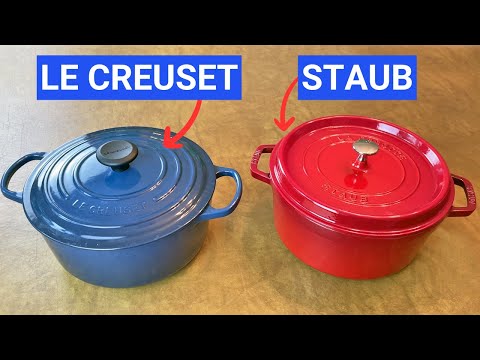
Staub 4-Quart Round Cocotte Review: The French Dutch Oven That Browns Better Than Le Creuset?

The Staub 4-Quart Round Cocotte is the other premium French Dutch oven — the one chefs reach for when they want a hard sear and a tight, self-basting lid. After cooking everything from short-rib braises to weekend bread loaves, here is the honest take. Bottom line: at roughly $280–$330, it is not cheaper than Le Creuset, but the matte black interior and lid-spike design make it a meaningfully different tool, and a better one for browning-heavy cooking.
What you're actually buying
Staub's 4-Quart Round Cocotte is enameled cast iron made in Turckheim, France. The 4-quart size serves three to four people and sits in a sweet spot — large enough for a whole chicken, small enough to live on the stovetop without dominating the burner. It comes in a range of colors (cherry, matte black, grenadine, basil, white, turquoise, graphite grey), and the cherry version we focused on is the closest visual analog to a Le Creuset signature red.
Two design choices set it apart from Le Creuset. First, the interior is matte black enamel, not cream. Staub's argument is that the rougher, darker surface develops a light patina, releases food more like a seasoned pan, and resists the staining that bothers some cream-interior owners. Second, the underside of the lid is studded with small bumps — Staub calls them self-basting spikes — designed to drip condensed steam back onto the food rather than running down the sides.
Other standard details: stainless steel knob rated to oven temperatures (around 500°F is the commonly cited figure, though confirm against current Staub guidance for your specific model year), a flat ground bottom for induction, and the usual lifetime warranty French enameled cast iron is known for.
Performance and real-world use
Where the Staub earns its premium is browning. The black interior tolerates and even rewards a hot, dry preheat, and meat goes from beige to fond-building brown faster than in a cream-interior pot. For braises that start with a hard sear — short ribs, lamb shanks, coq au vin — that head start is real. The self-basting lid lives up to its description in practice: lift it after 90 minutes of low-oven braising and condensation drips evenly, not just along the rim. The result is a slightly more concentrated braise.
For breads, the 4-quart is on the small side. A 750g boule fits, but a larger 900g–1kg loaf comes uncomfortably close to the walls. If sourdough is the main reason you are buying a Dutch oven, the 5.5-quart Staub or 7.25-quart Le Creuset is a better size match.
The downside of all that cast iron mass is weight. Empty, the 4-quart weighs around 11–12 pounds. Loaded with stew, it crosses into "two hands and a careful pivot" territory, and the side handles are short and integral — there is no extension to grip with mitts. After a year of use, the cherry exterior shows the typical light enamel crazing that Staub considers cosmetic and within warranty; the matte interior darkens evenly and gets easier to clean, not harder.
- Matte black interior browns meat better and is more forgiving than cream enamel
- Self-basting lid spikes actually do redistribute moisture during long braises
- Made in France with the longstanding Staub warranty on manufacturing defects
- Stainless steel knob is more durable than the phenolic knobs on older Le Creuset models
- Excellent heat retention — once hot, it holds temperature through long, low oven cooks
- Beautiful as a serving piece; cherry color reads more burgundy than the brighter Le Creuset red
- Heavy at roughly 11–12 pounds empty, and the short integral handles make two-hand lifts awkward
- Matte black interior makes it harder to judge fond darkness — you can scorch before you see it
- 4-quart size is too small for larger sourdough loaves and tight for a 4-pound roast
- Price often matches Le Creuset rather than undercutting it, despite a less iconic brand in the US
- Enamel can chip if dropped or knocked against a hard edge — treat it like glass-coated iron, not bare iron
Cooks who already do a lot of stovetop-to-oven cooking and want a pot that rewards aggressive searing. Households of two to four who do not bake very large loaves. Anyone who has been frustrated by stained cream interiors and wants the same heirloom build quality in a finish that hides use.
Solo cooks or couples who rarely cook for company — the 2.75-quart Staub or a 3-quart enameled iron from a budget brand will do the same job at less weight and lower cost. Heavy bread bakers should size up to 5.5 or 7 quarts. Anyone who values being able to see fond color clearly during a sear may prefer the cream interior of a Le Creuset.
The Staub 4-Quart Round Cocotte is not a budget pick and does not pretend to be. What it offers is a genuinely different cooking surface in a category where most premium pots look interchangeable. For braising and searing, the matte interior earns its keep; for bread, look at a larger size. 4.5 out of 5.