Victorinox Fibrox Pro 8" Chef's Knife Review: The Pro Kitchen Pick Under $50

If you ask twenty restaurant cooks what they actually have in their roll, a startling number will pull out the same plain-looking black-handled blade: the Victorinox Fibrox Pro 8-inch. Cook's Illustrated has recommended it for two decades. It costs less than a tank of gas. And after a couple of weeks of real prep work, the appeal is obvious — but so are the trade-offs nobody mentions in the love letters.
What you're actually buying
The Fibrox Pro is an 8-inch chef's knife with a stamped (not forged) high-carbon stainless steel blade and a textured, hollow-handled polymer grip Victorinox calls "Fibrox." It's made in Switzerland by the same company that makes the Swiss Army knives. The full-blade length is roughly 8 inches with a total length around 13 inches, and the knife weighs in noticeably lighter than European-style forged knives like Wusthof or Henckels — around 6 ounces compared to 8 to 10 ounces for a comparable forged competitor.
The blade has a relatively straight edge with a gentle belly, suited for a push-pull chopping motion more than the rocking technique a Wusthof encourages. The factory edge is sharpened around 20 degrees per side — typical for German-style knives, less aggressive than Japanese knives at 15 degrees, which is a deliberate trade for durability over screaming sharpness.
There are several variations sold under similar names — including the Swiss Classic line and the Fibrox Pro line — and packaging changes routinely. The Fibrox Pro variant under ASIN B008M5U1C2 is the one professional reviewers typically reference.
Performance and real-world use
What surprised me first was the balance. The handle is hollow and the blade is light, so the knife feels almost weightless in the hand compared to a Wusthof Classic. For long prep sessions — dicing five onions, breaking down a butternut squash, fine-chopping a pile of herbs — that lightness pays off in wrist fatigue, or rather, the lack of it.
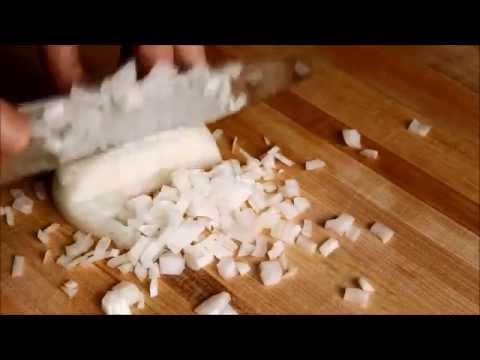
The factory edge cuts cleanly through ripe tomato skin and slips through onion layers with no crushing. After steady home use for a couple of weeks of normal cooking, the edge dulled gently — exactly what you'd expect from a stainless steel at this hardness. A few passes on a honing rod brought it right back. It is not a knife you sharpen once a year; plan on honing weekly and a real sharpening every few months if you cook most nights.
The Fibrox handle is the unsung hero. It's textured polymer that stays grippy when wet, which is more than I can say for the smooth wood scales on a Shun or the lacquered handle on some Wusthofs. You can wash it, you can drop it without weeping over a chipped buffalo horn bolster, and it disappears under your hand rather than demanding attention.
The downside in performance is the stamped blade construction. There's no bolster, no full tang you can see, and no heft to chop through a winter squash with authority — you do the work, the knife just gets out of the way. For a home cook doing 90% of normal kitchen tasks, that's fine and arguably better. For someone who wants the satisfying thunk of a forged blade through a sweet potato, this is not that knife.
- Cook's Illustrated / America's Test Kitchen has recommended this knife as a budget pick for roughly two decades — that's institutional consistency at a price point under $50.
- Lightweight (around 6 oz) reduces wrist fatigue during long prep sessions compared to forged German blades.
- Fibrox polymer handle is grippy when wet, dishwasher-tolerant per manufacturer (hand wash still recommended), and won't crack or stain.
- Factory edge is genuinely sharp out of the box — not all sub-$50 knives can say that.
- NSF-certified and ubiquitous in restaurant kitchens — meaningful real-world endorsement, not a marketing claim.
- Easy to sharpen on a basic stone or pull-through; the softer stainless responds well to amateur sharpening.
- Stamped blade lacks the heft for confidently chopping dense produce like winter squash or hard root vegetables; it requires more downward force than a forged knife.
- No bolster means less protection between your fingers and the blade — newer cooks may find this less reassuring than a knife with a finger guard.
- The polymer handle is functional but unattractive; this is a tool, not an heirloom, and it looks the part.
- Edge retention is shorter than premium Japanese knives at higher hardness ratings — you'll hone more often.
- "Fibrox Pro" naming and packaging shifts make ASIN selection confusing; multiple near-identical SKUs exist on Amazon.
- Not a knife to display on a magnetic rack and feel proud of — the visual appeal is essentially zero.
Home cooks who want one knife that handles 90% of daily kitchen tasks without dropping $150-plus on a forged blade. Renters who don't want to grieve a chipped tip. Anyone teaching a partner or teenager to cook, where the low replacement cost makes it a forgiving training knife. Cooks who already own a beautiful forged knife and want a workhorse beater for citrus, raw chicken, or anything that risks staining nicer steel.
People who want the satisfying weight and balance of a forged German or Japanese knife as part of the cooking experience — the Fibrox is functional, not pleasurable, and that distinction matters to some cooks. Anyone planning to do heavy butchery or break down hard squashes daily; the lack of bolster and lighter blade make those tasks more work. Collectors or gift-buyers who want something that looks the part — this knife is plain on purpose.
The Victorinox Fibrox Pro 8-inch chef's knife is one of those rare products where the institutional endorsements (Cook's Illustrated, professional kitchens worldwide) are completely earned. It is not the most beautiful knife in any kitchen, and it is not the sharpest knife you can buy — but for under $50 it does the daily work of a chef's knife better than knives that cost three times as much. Rating: 4.5/5, with the missing half-point owed entirely to the lack of heft for heavy tasks and a workmanlike appearance that some cooks will not love.