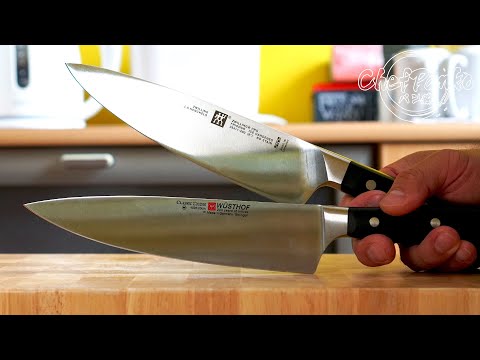
Wusthof Classic Ikon 8" Chef's Knife Review: The Double-Bolster German Workhorse

The Wusthof Classic Ikon takes the same forged blade that made the original Classic a kitchen staple and rebuilds the handle around it. A contoured grip, a half-bolster that exposes the heel, and a second rear bolster for balance are the headline changes. If you're choosing between Wusthof's two main lines, this is the more comfortable, more agile, and more expensive option.
What you're actually buying
The Classic Ikon is an 8-inch forged chef's knife made in Solingen, Germany. The blade is a single piece of Wusthof's proprietary high-carbon stainless steel (the same alloy used across the Classic line), precision-forged and hardened to roughly 58 HRC. The edge is laser-cut and finished with Wusthof's Precision Edge Technology (PEtec) — a computer-controlled bevel that's narrower and sharper out of the box than the older hand-finished grind.
The two visible departures from the Classic are the handle and the bolster. The Ikon's handle is a triple-riveted black polyoxymethylene (POM) with a contoured, ergonomic shape rather than the Classic's straight, square profile. The bolster is split: a partial finger guard up front, and a second contoured bolster at the rear for balance. The half-bolster exposes the full heel of the blade, which makes sharpening on a stone significantly easier than on the Classic's full-bolster design.
The knife arrives in a printed Wusthof box with a basic care card. There's no sheath, no certificate, and no sharpening service voucher — Wusthof's free factory sharpening for life is the warranty everyone references, and it does still apply.
Performance and real-world use
Out of the box, the PEtec edge is shaving sharp. The bevel angle is roughly 14 degrees per side — wider than a Japanese gyuto's 12 degrees, narrower than the older Wusthof grind at 17. In practice that means it bites into tomato skin without crushing and rocks through onions cleanly, but it's not the laser that a thin-spined Japanese knife will be.
The grip is where the Ikon earns its premium over the Classic. The contoured handle settles into a pinch grip without any of the hot spots that Classic owners learn to ignore. For long prep — a brunoise, big mirepoix batches, breaking down a whole chicken — the difference is noticeable. The rear bolster shifts the balance point right at the heel, which most testers prefer for rocking cuts.
The half-bolster is the practical upgrade hiding behind the cosmetic one. On the Classic, the full bolster eventually creates a heel that's higher than the rest of the edge, and sharpening that out requires grinding the bolster down — a job most home cooks send to a pro. The Ikon's exposed heel lets you maintain the full edge on a whetstone or pull-through sharpener from day one.
Edge retention is solid for a German knife but not remarkable. Expect to hone before each session and stone or pull-through sharpen every six to eight weeks of regular home use. The blade is dishwasher-rated by Wusthof, but every reviewer who's tracked long-term wear says hand-washing keeps the handle and edge in better shape.
- Contoured triple-riveted handle is comfortably the best part of the upgrade over the Classic
- PEtec edge is sharp out of the box and easier to maintain at the original geometry
- Half-bolster exposes the full heel, making sharpening genuinely practical at home
- Full-tang forged construction in Solingen with Wusthof's lifetime warranty and free factory sharpening
- Balance shifts toward the blade-handle junction, which suits rocking cuts better than the Classic
- $50–$80 premium over the Classic for what is, functionally, the same blade
- Heavier (~9 oz) than comparable Japanese 8-inch gyutos, which matters over long prep
- POM handle is durable but looks and feels like high-grade plastic — not the wood or G-10 some buyers expect at this price
- 58 HRC steel needs more frequent honing than harder Japanese alternatives
- The two-bolster design is decisive — some pinch-grip cooks find the rear bolster pushes their hand forward in a way they don't like
Home cooks and line cooks who already know they prefer a German-style knife — sturdier, heavier, more forgiving of bone contact and twist — and who want the comfort and serviceability the Classic doesn't deliver. It's also the right pick for anyone planning to actually maintain their own edge on a stone, because the half-bolster is a real, ongoing benefit.
Cooks chasing thin, light, ultra-keen slicing should go Japanese (Tojiro, Misono, Shun) — the Ikon is a workhorse, not a scalpel. Anyone happy with their Wusthof Classic shouldn't spend the upgrade money; the blade is identical. And if you want a wood or composite handle at this price, the Wusthof Ikon Blackwood line or a Henckels Pro exists.
The Classic Ikon is the most comfortable, most maintainable knife in Wusthof's standard catalog, and the half-bolster is a meaningfully better design than the Classic's full-bolster for anyone planning to keep the knife sharp themselves. Whether the $50–$80 premium over the Classic is worth it comes down to how much your hand notices the difference over a long prep session — for many cooks, it absolutely is. **Rating: 4.5 / 5.**