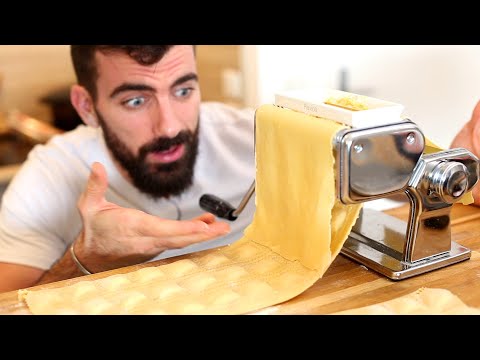
Marcato Atlas 150 Pasta Machine Review: The Made-in-Italy Workhorse Worth Saving Counter Space For

If you have ever wandered into a serious home cook's kitchen and seen a chrome contraption clamped to the counter with a hand crank sticking out, odds are it was a Marcato Atlas 150. Made in Italy and effectively unchanged in design for decades, it has become the default recommendation for home pasta makers. After looking at how the Atlas 150 actually performs in long-term home use, the short version is: it earns the reputation, with a couple of caveats worth knowing before you buy.
What you're actually buying
The Atlas 150 is a manual, hand-cranked pasta machine with a 150 mm (about 6-inch) roller width. The body is chrome-plated steel, the rollers and cutters are anodized aluminum, and the whole thing weighs around six pounds. It clamps to a counter or table edge up to roughly 1.2 inches thick.
Out of the box you get the machine itself, one removable cutter head that produces two pasta shapes — typically fettuccine and tagliolini — plus a hand crank and a printed instruction sheet. There is a numbered dial on the side with nine thickness settings, ranging from a thick first pass down to nearly translucent sheets at the highest setting.
The Atlas 150 is also the entry point into a much larger accessory ecosystem. Marcato sells more than a dozen additional cutter heads (pappardelle, spaghetti, ravioli, lasagnette, and others) plus an electric motor attachment that replaces the hand crank. Everything is compatible across decades of Atlas 150 production, which is part of the long-term value proposition.
Performance and real-world use
What the Atlas 150 does well is consistency. The rollers are precisely machined and the gap between them changes in fixed, repeatable steps, so the sheet you produced last weekend is the same thickness as the sheet you produce next weekend at the same dial setting. That predictability is what separates a good fresh-pasta night from a frustrating one.
The hand crank is smooth and the gearing makes it light work even when laminating stiff egg-and-flour doughs. Pasta sheets come out cleanly with no tearing as long as the dough is properly rested and lightly floured. The cutter head produces clean, well-separated strands rather than the smashed, stuck-together ribbons that cheaper machines tend to deliver.
The biggest practical drawback is cleaning. Marcato is emphatic that the machine should never be washed with water — the internal gears and rollers are not stainless and will rust or seize. Cleaning is done with a stiff brush and a wooden skewer for stuck bits, and most owners do a final pass by running a piece of stale dough through the rollers to pick up residue. This works, but it is a learning curve compared to throwing a bowl in the dishwasher.
The clamp also assumes a fairly thin counter edge. On thick butcher-block counters or many modern kitchen islands, the clamp will not bite, and you will need to use the machine on a separate table or a sturdy cutting board placed near an edge.
- Made in Italy with a build quality that genuinely holds up for years of regular use
- Precisely repeatable thickness across nine numbered settings
- Smooth hand crank that handles firm doughs without skipping
- Massive accessory ecosystem — cutter heads and an electric motor available separately
- Compact footprint and easy to store between uses
- Resale value stays high; used Atlas 150 units consistently sell well
- Cannot be washed with water, which is non-obvious to first-time owners
- Counter clamp does not fit thick or rounded counter edges
- Only one cutter head included; extra shapes are sold separately and add up quickly
- Hand-cranking sheets requires two people in practice, unless you prop the dough
- No built-in pasta drying rack or storage for the cutter head
This is the machine for someone who wants to make fresh pasta a recurring habit — once a month, every other weekend, that kind of cadence — and is willing to learn its quirks. It is also a good gift for an enthusiastic home cook who is already comfortable with hand tools and would rather have one machine that lasts a couple of decades than a plastic appliance that gets replaced.
If you are pasta-curious but uncertain whether you will use the machine more than a few times a year, the Atlas 150 is overkill, and a cheaper rolling pin or a stand-mixer pasta attachment may be a better fit. Anyone who cannot commit to the no-water cleaning routine should also pass — the machine is durable, but only if it stays dry.
The Marcato Atlas 150 is the rare kitchen tool that genuinely deserves its long-running reputation. It is not perfect — the cleaning rules and clamp limitations are real — but the consistency, build quality, and long-term ecosystem make it the right default choice for home pasta. Rating: 4.5/5.